Bulgarian
maximum cards
on eBay
- fake or not?

Page 1

Page 2

Page 3


IV. Comparisons and analysis of "maximum cards" and cancellations

By studying dozens of "maximum cards" offered at eBay the last month, I have found at least 4 different cancels that are repeatedly used. It is strongly advised that possible buyers watch out for these!


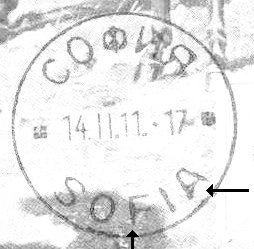
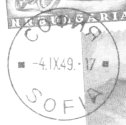
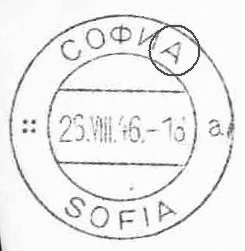
#C1:

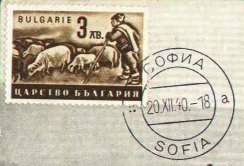
This cancel is without doubt fake! SOFIA in Cyrilic is not spelled with "A" but "JA" (inverted "R").

The origins of this cancel is not clear, though. It can be a total fake made outside Bulgaria as the spelling error should have been obvious to a Bulgarian. It can also be a rejection thrown away by the maker or the postal authorities and later stolen.

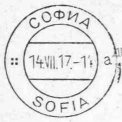
Such a 2-ring cancel is typical in later Bulgarian machine cancels. According to [1], however, this specific cancel with counter "a" in outer ring did not exist in Sofia before 1950. Most likely this type was used from the 1960's up to the 1980's.
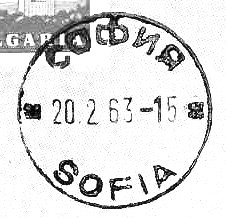
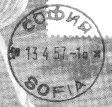
#C2:

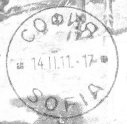
This cancel is probably an original Sofia cancel. However, by looking at it's use we can prove that the "maximum cards" made with this cancel must be fake. Note the poor quality of the Cyrillic "SOFIA" in the upper part of the cancel, and especially the characteristic smears in the middle of the "F" and on the left part of the "A" in the Latin "SOFIA".

According to [1] no such Sofia cancel existed before 1950 with Roman letters for month, 2-digit year, 24-hour time and dot between year and time.
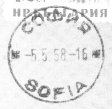
#C3:

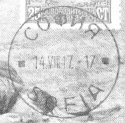
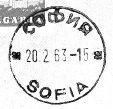
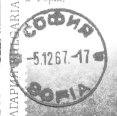
This cancel has such poor quality that it is doubtful that the postal authorities would have used it to make maximum cards. Also in this case the period of use causes suspicion that maximum cards with this cancel are fake. Maybe this is a cancel that was thrown away by the postal authorities due to wear and tear and then stolen?

Compared to #C2 above, this cancel uses digits for months instead of letters, and has a hyphen ("-") between date and time instead of a dot.

Original time of use of this cancel is not known.
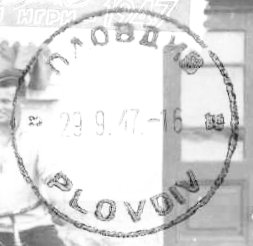
#C4:

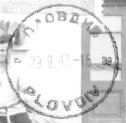
This is the only non-Sofia cancel I have seen on these "maximum cards". As for #C3 above, the cancel seems to be too worn for "official" maxicard production. This could therefore also be an old cancel thrown away and later stolen.

Note that the symmetry of the letters in "Plovdiv" is very poor. This cancel could actually be a complete fake!

Original time of use of this cancel is not known.


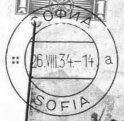
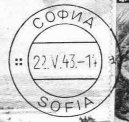
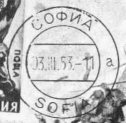
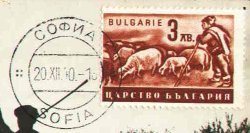
#C1: 2-ring cancel with spelling error

Take a look at the time of use of this cancel....


1917

1934

1943

1953

Even without the spelling error there is no way that the same cancel could have been used for such a long time!!

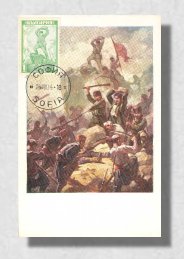
To further prove that the "maximum cards" with this cancel is fake, we can look at these two samples: According to my Michel catalog the 3 Leva stamps in this set were issued in 1943 and 1944 respectively. Only the 10 St and 30 St values of the set were issued in 1940. An original cancel on these stamps with the date 20.12.1940 is impossible!


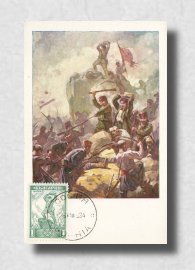
Furthermore, it is difficult to see any concordance between the postcard showing the Bulgarian army crossing the river Morava during the 1st World War and stamps picturing a farmer with his ox, or even the Sevlievo flooding surcharges, and a cancel from Sofia...


1913

1939


#C2: 1-ring cancel with smears in "F" and "A"

Take a look at the time of use of this cancel as well....


1911

1917

1934

1949

Again, there is no way that the same cancel could have been used for such a long time!! Even if the cancelling was done by the postal authorites, these "maximum cards" are back dated with one identical cancel.


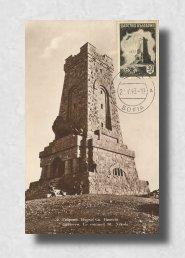
... and what is the concordance between the battle of the Schipka pass and a Sofia cancel...??


#C3: 1-ring cancel of very poor quality


1957

1958

1963

1967

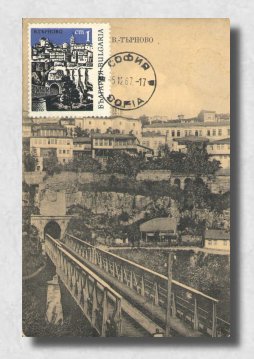
I am not completely sure all these pictures show the same cancel, but they are all of such poor quality that it is doubtful that the postal authorities would have used them for maxium card cancellations. IF the "1957" cancel is the same as the "1967", these must also have been back dated and cancelled at a later time.


It is again difficult to see any concordance between the train bridge of Tarnovo and this Sofia cancel...


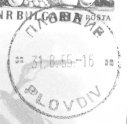
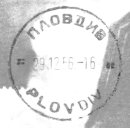
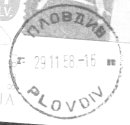
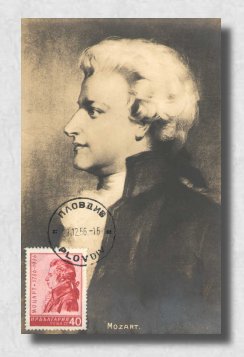
#C4: 1-ring cancel from Plovdiv of very poor quality


1947

1955

1956

1958

I have only found this cancel used over the limited time span shown above. It is still doubtful that the postal authorities would use such a poor cancel over 11 years... Furthermore, it is quite unknown to me what the concordance between Mozart and Plovdiv might be...


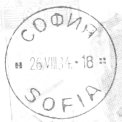
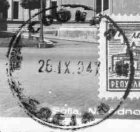
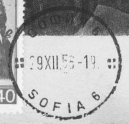
Finally, I want to show two other cancels from the district "Sofia 6" that are used on a few of the items I have studied. The left cancel has a 3-digit year, while the right cancel has a 2-digit year plus time.


1947

1956

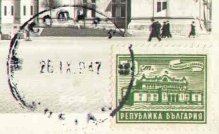
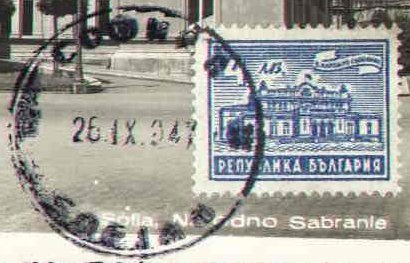
I don't have any further information about the right cancel. The left one, on the other hand, has again too poor quality for "official" maximum card use. Furthermore, the "producer" of these cards made a mistake that proves that the cards with this cancel are definitely fake! According to my Michel catalog the 50 St stamp shown left below was issued 07.11.1947 and the 4 Leva stamp shown right below 09.01.1948. But both are cancelled 26.09.1947 when the first stamps in this set was issued...


V. Conclusions

It is of course not possible to give specific proofs only by looking at internet pictures. However, based on the comparisons and analysis above (which shows only a small fraction of the items offered at eBay that I have studied), the following conclusions can be given:
  1. Very few, if any, of the older items offered fulfill the FIP criteria for Maximum Cards: Concordance of place and time between card, stamp and cancel. At most, the offered items are simply cards with a stamp tied with some cancel.
  2. Several of the cancels have so poor quality that it is doubtful that postal authorities would have used them to make maximum cards.
  3. Some of the cancels seem to have been used over a time span of 30-40 years. This would not be possible with true postal cancellations, proving that these items are made at a later time and just back dated.
  4. None of the Sofia cancels used on these items existed before 1950, further proving that items are back dated.
  5. Some of the items are cancelled with a date before the stamp was actually issued, at least proving that those items are fake.
  6. One of the cancels has a bad spelling error and would not have been used by the postal authorities. It is therefore either a rejection thrown away and then stolen, or a complete fake. In the latter case, it is most likely made outside Bulgaria.
Are then all these cards fake or not? Well, if you think the above conclusions are sufficient to warrant the use of the term "fake" the answer is YES. At least, it is definitely fraudulent - knowingly or not - to list and sell these items at eBay with terms like "old", "rare" and "Very very rare!". I sincerely hope we have now seen the end to these listings at eBay!

-Indeed?? Then read Section VI. The story continues...


This page is made in cooperation with T. Hitzler, Germany.

Reference:

[1] P. Kourdalanov, Y. Kozarev: "Postmarks and Seals of Sofia in the 20th Century", Sofia, 1989